テレビは持っていません – I don’t own a TV
📍 Target Market: Japan
🔥 Trend: 立花孝志 破産 (Takashi Tachibana bankruptcy) ↗
Japan is currently abuzz with the news surrounding Takashi Tachibana, the prominent leader of the anti-NHK party, whose bankruptcy proceedings have officially commenced. This development isn’t just a political footnote; it has sent ripples through the nation, reigniting discussions around a deeply ingrained cultural flashpoint: the mandatory NHK television license fee. It’s a moment where public sentiment, political discourse, and everyday humor intersect, creating a unique opportunity for culturally resonant design.
The Cultural Significance
The saga of Takashi Tachibana and his anti-NHK party has long captivated a segment of the Japanese public. While the political specifics of his bankruptcy are making headlines, the underlying reason for his party’s existence—the widespread frustration with Japan’s compulsory NHK receiving fee—is an evergreen topic. Nearly every household in Japan with a TV is legally obligated to pay this fee, regardless of whether they watch NHK programming. This has fostered a common, almost legendary, cultural workaround: simply telling the fee collectors, “テレビは持っていません” (I don’t own a TV). It’s a phrase uttered with a knowing wink, a shared defiance, and a touch of humor that resonates deeply across demographics. This design concept deftly sidesteps the political controversy to tap into this universal, relatable sentiment, transforming a national debate into an inside joke for a broad audience.
Design Brainstorm: Capturing the Aesthetic
Translating a nuanced cultural sentiment into a compelling design requires both subtlety and immediate recognition. This approach aims for a nostalgic, understated aesthetic that speaks volumes without being overtly political.
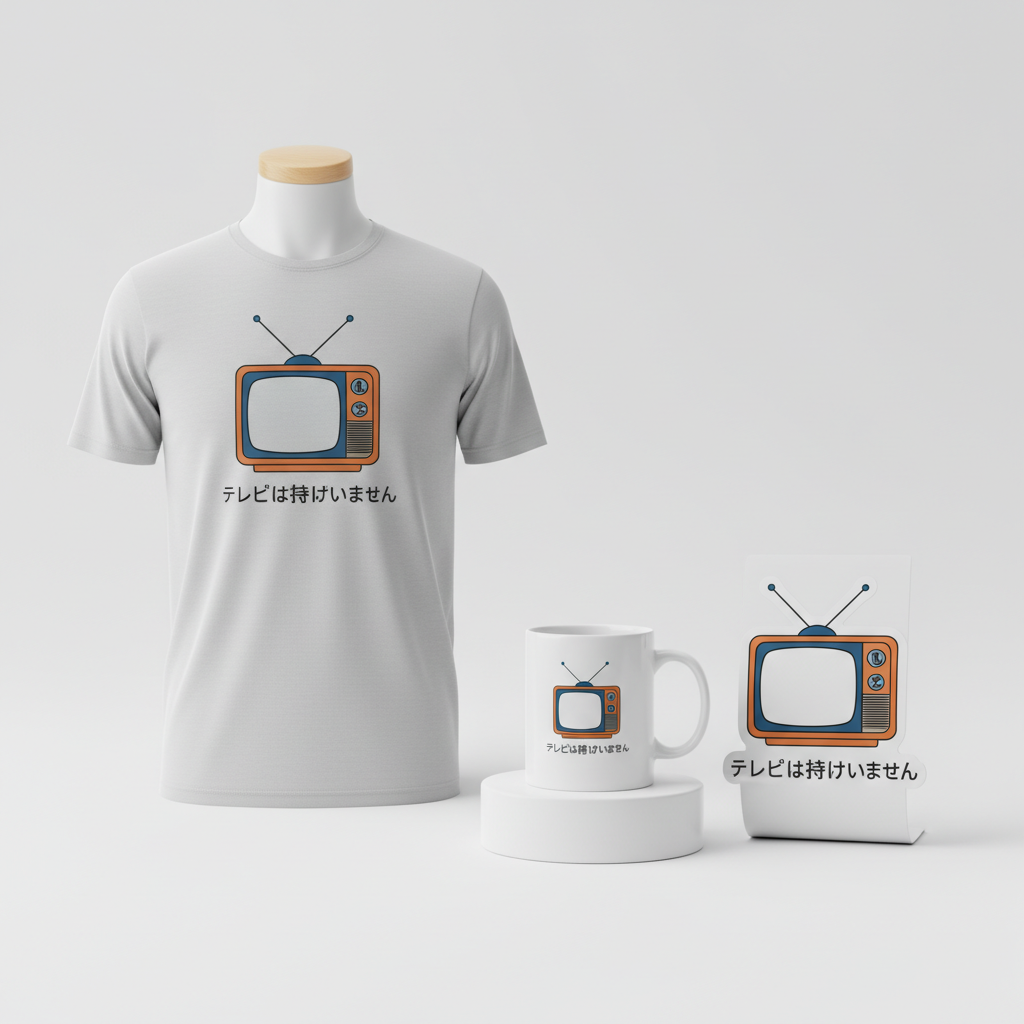
- 🎨 Visual Concept: One angle to consider is a simple, slightly retro illustration of an old-fashioned cathode-ray tube (CRT) television set. The charm of a vintage TV evokes a sense of nostalgia, while its blank screen cleverly symbolizes the “lack” of a television—and by extension, the evasion of the NHK fee. This visual is iconic and immediately recognizable, yet it remains neutral, allowing the text to carry the specific cultural weight.
- ✍️ Typography Ideas: Below the retro television, the Japanese text “テレビは持っていません” could be written in a clean, standard Mincho (serif) font. Mincho fonts are classic and convey a sense of reliability and tradition, which offers an interesting contrast to the humorous, slightly rebellious message. The straightforwardness of the font allows the phrase itself to be the star, making the inside joke clear and impactful to those in the know.
- 👕 Product Canvas: This design could translate well to light-colored apparel. T-shirts in crisp white, heather gray, or soft pastels would allow the simple, clean lines of the retro TV and the distinct Mincho text to stand out. The lightness of the fabric complements the design’s understated humor, making it a casual, wearable statement piece rather than a loud declaration.
Strategic Market Insight
The strategic brilliance of this design concept lies in its pivot away from direct political endorsement, focusing instead on a shared cultural experience. The target audience isn’t just people interested in Takashi Tachibana’s politics, but a much broader swath of Japanese society who are familiar with, and perhaps a little weary of, the NHK fee. Purchasing this item becomes a subtle nod of solidarity, a way to express a shared understanding or a quiet form of lighthearted rebellion. The psychological triggers behind such a purchase include belonging to a “knowing” group, appreciation for clever, understated humor, and the satisfaction of expressing a common sentiment without being confrontational. It’s a relatable inside joke that resonates on a personal and communal level, making it highly appealing for those seeking unique, culturally specific merchandise.
⚖️ Estimated Copyright Risk: LOW
Risk Assessment: The design avoids the politician’s name, likeness, and his party’s name. The quote used is a common, generic phrase used in daily life in Japan and is not a trademarked slogan. The design is based on a shared cultural experience, not a specific political entity, making it safe for POD.
Always verify intellectual property rights before listing.
Check Japan Trademark Search for “立花孝志 破産” ➔
AI Image Generation Prompts
The following prompts are optimized for leading generators to produce production-ready assets:
👕 Apparel / T-Shirt Prompt
A simple, slightly retro illustration of an old-fashioned cathode-ray tube television set, isolated on a solid Light background. The TV is depicted with a vintage, bulky form factor, featuring classic chunky dials, prominent push-buttons, and a visible rabbit-ear antenna. The television screen is completely dark and blank, with a subtle convex curvature visible, hinting at the CRT glass. Below the television, the Japanese text 'テレビは持っていません' is written in a clean, standard Mincho (serif) font, perfectly centered. The art style is a clean vector illustration, characterized by crisp, geometric lines, smooth Bézier curves, and a limited, tasteful color palette dominated by muted retro tones like cream, warm beige, soft olive green, and a deep charcoal grey for accents, with pure black for the screen. Shading is minimal, utilizing subtle flat gradients or distinct color blocks to suggest form and depth without being photorealistic. The overall rendering exudes a mid-century modern graphic design aesthetic, suitable for screen printing with distinct, unblended colors. The mood is nostalgic, iconic, and minimalist. The illustration is sharp, high-resolution, and perfectly centered within the frame, ensuring clarity and impact for a t-shirt print. The ONLY text allowed in the image is exactly 'テレビは持っていません'. Absolutely NO other names, words, or random letters. --ar 3:4 --v 6.0
🔍 Search this niche on:
☕ Drinkware / Mug Prompt
A duplicated side-by-side layout showing the exact same graphic on the left and right, designed perfectly for a panoramic mug wrap. The graphic features a simple, slightly retro illustration of an old-fashioned cathode-ray tube television set. The TV is stylized with soft, rounded corners on its chunky plastic casing, complete with two prominent retro dials and a simplified antenna at the top. The television screen is entirely blank, represented by a deep, matte black rectangle with a subtle inner shadow to imply depth, avoiding any reflections. Directly below the TV, the Japanese text 'テレビは持っていません' is rendered in a clean, legible standard Mincho (serif) font. The art style is a vibrant yet warm flat design, utilizing a limited palette of inviting retro colors such as burnt orange, muted teal, cream, and a rich chocolate brown, with crisp, thin outlines defining shapes. The rendering is smooth and clean, reminiscent of 1970s print advertisements, optimized for readability and visual appeal on a curved surface. There are no harsh shadows or excessive textures; instead, it relies on bold, solid color blocks and precise linework. The mood is comforting, nostalgic, and subtly playful, ideal for a coffee mug. The duplicated graphics are seamlessly aligned for a continuous wrap. The ONLY text allowed in the image is exactly 'テレビは持っていません'. Absolutely NO other names, words, or random letters. --ar 3:1 --v 6.0
🔍 Search this niche on:
✨ Die-Cut Sticker Prompt
A die-cut sticker design featuring a simple, slightly retro illustration of an old-fashioned cathode-ray tube television set, encased within a thick white outline border around the entire design. The TV is depicted in a bold, 2D flat pop-art style, with exaggerated, iconic features like an oversized channel dial and a prominent volume knob, and a simplified rabbit-ear antenna. The television screen is completely blank, represented by a solid dark grey rectangle, devoid of any glare or detail. Below the television, the Japanese text 'テレビは持っていません' is written in a clean, impactful standard Mincho (serif) font, rendered in a solid contrasting color. The art style is defined by strong, clean black outlines, filled with vibrant, solid block colors reminiscent of classic comic book panels or 1960s pop art posters, such as bright primary yellow for the casing, a vivid royal blue for the buttons, and a deep red for the antenna tips. The rendering is extremely flat, sharp, and graphic, with no gradients, subtle textures, or realistic shading. The overall aesthetic is punchy, high-contrast, and instantly recognizable. The thick white outline acts as a distinct border, making the sticker stand out visually. The mood is playful, bold, and iconic. The ONLY text allowed in the image is exactly 'テレビは持っていません'. Absolutely NO other names, words, or random letters. --ar 1:1 --v 6.0
🔍 Search this niche on:
Frequently Asked Questions
Is this design overtly political?
Not at all. While the underlying context is rooted in a political movement, the design cleverly pivots to a widely understood cultural meme. The phrase “I don’t own a TV” is a common, humorous excuse for avoiding the NHK fee, making the apparel a subtle, non-confrontational inside joke rather than a direct political statement. It’s designed to be universally relatable to anyone familiar with the NHK fee situation in Japan.
Who is the ideal buyer for this type of merchandise?
The ideal buyer is someone who appreciates subtle humor and shared cultural experiences. This could include anyone in Japan familiar with the NHK license fee, expats living in Japan, or even those with a strong interest in Japanese pop culture and social quirks. It appeals to individuals who enjoy wearing designs that spark knowing smiles or quiet recognition from others, rather than bold, explicit statements.
What other products could effectively carry this design?
Beyond light apparel like t-shirts and hoodies, this design could be incredibly effective on a range of products where subtle statements are appreciated. Think tote bags, coffee mugs, phone cases, and even stationery items or vinyl stickers. The clean, retro aesthetic and the impactful text make it versatile for items that become part of daily life, allowing the humor to be subtly integrated into various contexts.
Final Thoughts
The ability to identify and tap into unique cultural moments, especially those with a humorous, universally understood undercurrent, is a powerful asset in the e-commerce space. This trend surrounding the NHK fee and its popular deflection phrase, sparked by current events, offers a prime example of how everyday frustrations can be transformed into compelling, relatable merchandise. Success in this niche hinges on understanding the nuances of the target culture and delivering designs that resonate deeply, sparking recognition and a quiet chuckle. Ultimately, the potential for culturally specific, subtly humorous designs remains vast, and creative execution is always the key to unlocking its full e-commerce potential.
💬 What’s Your Take?
Art is subjective, and this is just one angle! How would you spin this “立花孝志 破産 (Takashi Tachibana bankruptcy)” trend? Did we miss the mark, or is there a better inside joke to use here? Drop your design ideas and let’s brainstorm in the comments below!